Andrej Karpathy coined the term “vibe coding” in early 2025—originally as a half-joke about how engineers began using AI to write code that looked right, even if its inner workings were a mystery. Within a year, what started as a playful observation became a serious challenge across the industry.
According to CIO, companies are replacing established enterprise software with AI-generated alternatives, only to find that maintenance, security, and support become their sole responsibility. One technology advisor noted that while AI initially seems like an excellent partner, excessive autonomy leads to inaccuracies and overlooked safeguards that are difficult to correct. Gartner predicts that by 2028, 40% of projects built primarily with AI-generated code will be canceled or require significant rework.
In compensation, these same software risks can result in critical issues such as undetected pay equity gaps, misapplied market data, or errors in regulatory compliance. For example, an AI-generated pay model might overlook jurisdiction-specific requirements or fail to reflect internal pay parity, exposing the organization to risk and eroding employee trust. Such problems are difficult to unwind once embedded in key compensation decisions.
The Problem with Generic AI in Compensation
There are two sides of the same problem. The first side is familiar to most compensation leaders. Recruiters use ChatGPT to determine market rates for roles such as Staff Engineer in Austin, often receiving figures misaligned with your salary bands. Hiring managers rely on generic AI to assess offer competitiveness without peer-group data or internal equity context. FP&A teams model merit budget scenarios with tools that lack insight into pay-for-performance relationships. These individuals are not acting recklessly; they are being resourceful in the absence of better options.
The second side—less discussed but potentially more significant—is that compensation and HR teams themselves are engaging in vibe compensation.
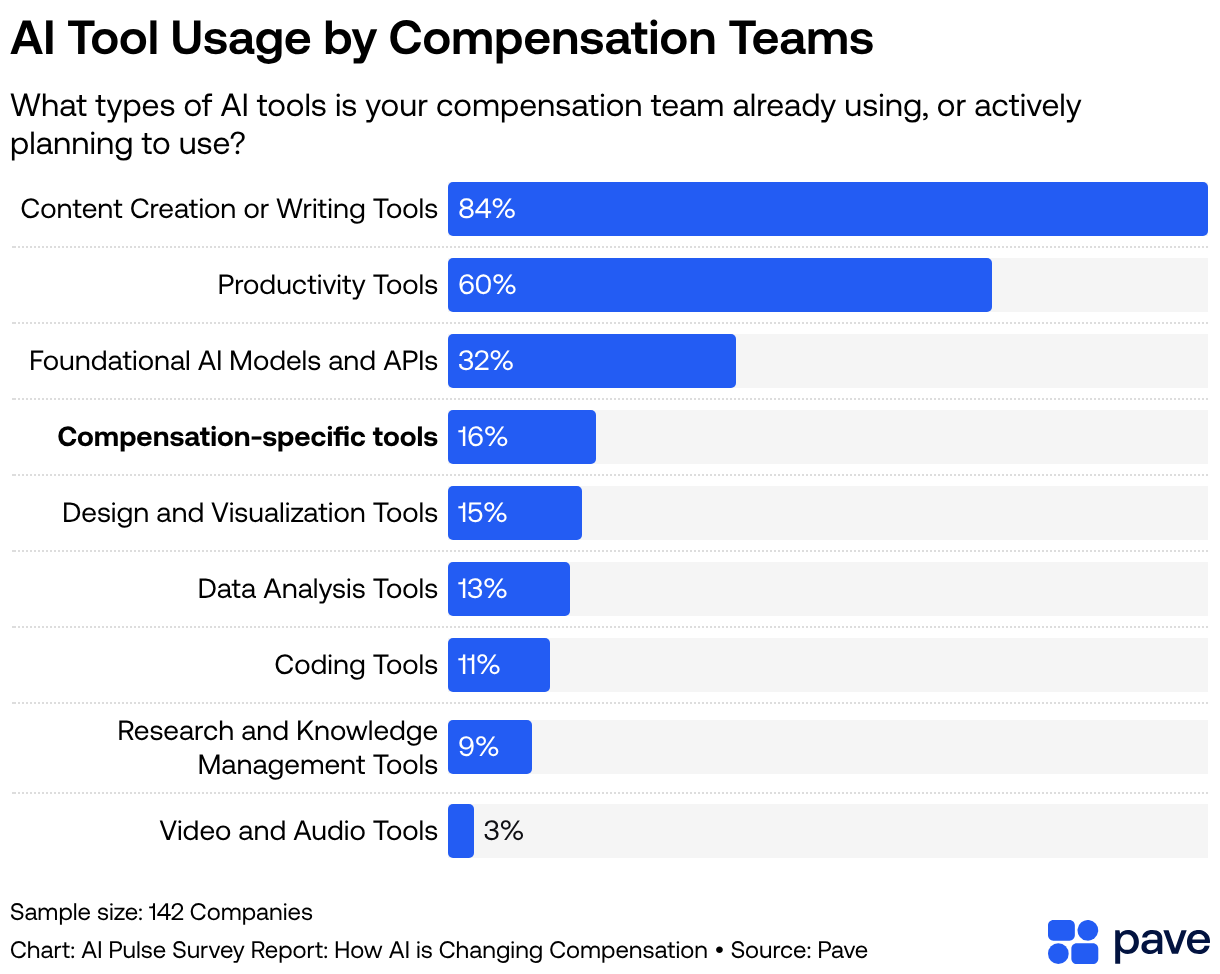
Pave’s How AI is Changing Compensation research found that 84% of compensation professionals already use some form of AI in their work. Most use it for content creation and employee communications, such as drafting job descriptions, summarizing policies, and writing talking points for managers. These are low-risk, high-convenience tasks. Compensation teams should experiment with AI, as it accelerates the function. Teams that do not engage risk falling behind.
The challenge is not experimentation, but knowing where to set boundaries. Leading compensation teams make this distinction intentionally: they identify when to build—experimenting with AI, prototyping workflows, and accelerating low-risk tasks—and when to buy purpose-built tools that provide governance, data integrity, and auditability. Drafting a manager FAQ is a build; pricing 200 roles against the market during a planning cycle is a buy.
The gap between drafting compensation communications and pricing a new job family is smaller than most teams realize. Once a tool gains trust for simple tasks, it is often used for more complex ones. Generic AI does not indicate when a request shifts from low-risk to high-stakes; it simply provides an answer.
Vibe Coding or Vibe Compensation?
Only 16% of compensation professionals use compensation-specific AI tools. According to our 2026 AI Maturity benchmarking, just 11.8% use AI for pay recommendations. This means most compensation teams rely on the same generic tools as the rest of the organization—tools that do not understand your percentile targets, equity refresh philosophy, or how your leveling framework aligns with market data. These tools do not identify their own limitations.
Most compensation teams have experienced this scenario: an Excel expert builds a model for the merit cycle, and when that person leaves, no one understands the formulas, assumptions, or logic. The model functions until it fails, with no clear explanation. Vibe-coded compensation solutions present the same institutional knowledge risk, but they scale more quickly and leave even less documentation. While spreadsheets display formulas, a prompt history in ChatGPT does not constitute a methodology.
This is vibe compensation: AI makes it easy to generate compensation outputs—such as salary bands, job architectures, leveling frameworks, and pay equity analyses—without the organizational context, governance, or expertise needed to make those outputs defensible. Unlike vibe-coded software, where a bug eventually causes a visible issue, vibe compensation failures are subtle and accumulate over time before being detected.
Compensation Debt: The New Technical Debt
In software, vibe coding leads to technical debt—inconsistent patterns, hidden bugs, and unsupported architectures that become increasingly costly to maintain. Vibe-coded projects accumulate this debt approximately three times faster than those developed traditionally.
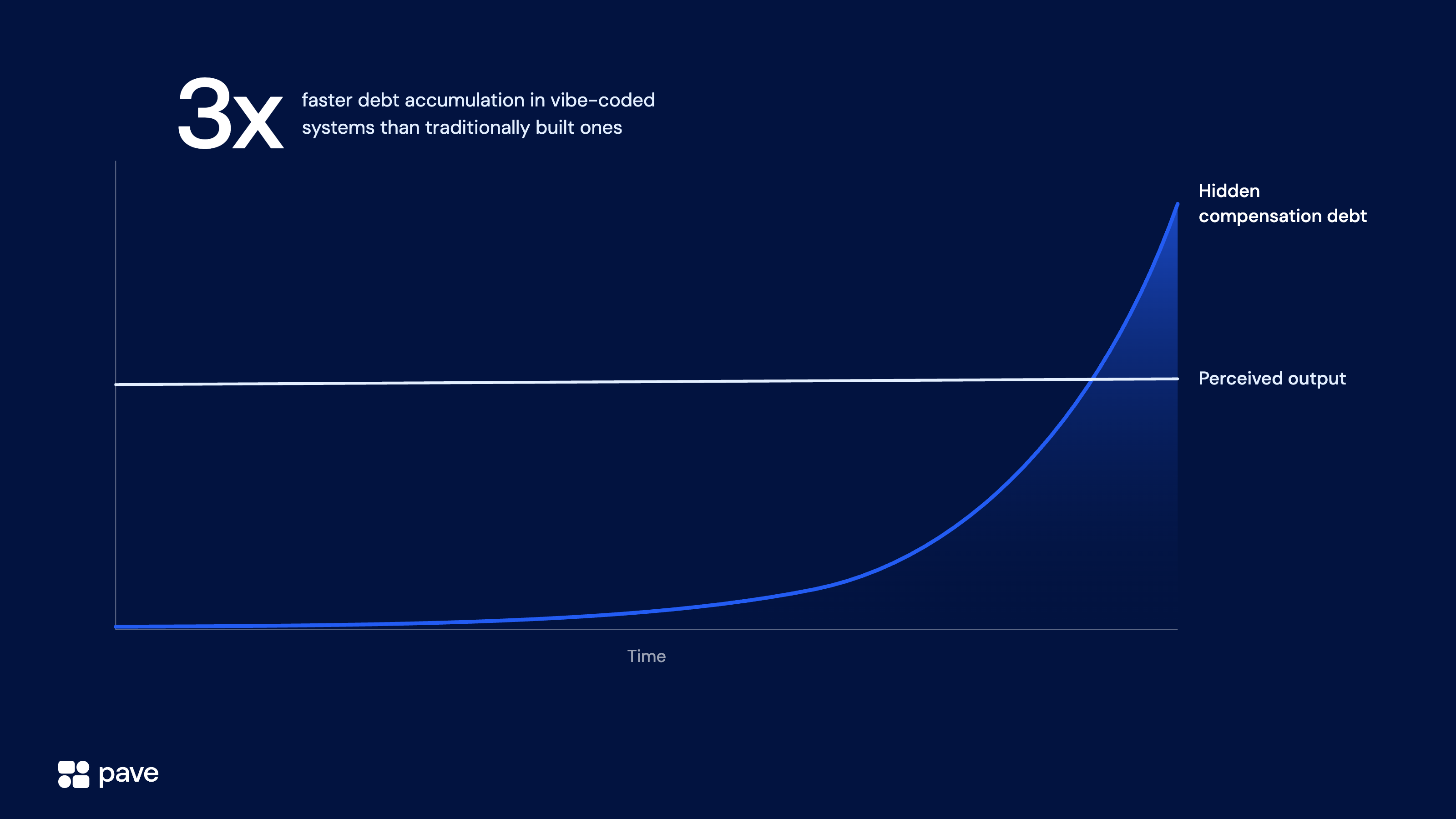
Compensation faces a similar challenge, known as compensation debt: the accumulation of inconsistent, poorly governed, or hastily generated pay decisions that result in long-term risk, inequity, and operational complexity.
When frontline leaders engage in vibe compensation, the resulting debt is scattered, such as an off-market offer or an inconsistent band. When the compensation team itself does so, the debt becomes structural. A leveling framework created without a full organizational context becomes the basis for all subsequent decisions. Pay ranges built on generic benchmarks become embedded in planning cycles. Manager guidance developed without philosophical alignment leads to inconsistent behaviors across the organization. When the person who built the AI-assisted workflow departs, the logic, assumptions, and methodology leave as well.
The challenge is that compensation debt, like technical debt, often appears acceptable on the surface. Salary bands exist, equity analyses are produced, and manager talking points are drafted. However, the underlying coherence—the alignment between your compensation philosophy and actual decisions—is gradually eroding.
Our maturity data highlights the gap: 81% of companies with a documented compensation philosophy do not use AI for pay recommendations. The philosophy exists, but the infrastructure to operationalize it with AI does not. This creates a system prone to drift.
Early warning signs of compensation debt can help leaders catch these issues before they escalate. Signs include unexplained variances in pay for similar roles, repeated one-off exceptions outside established guidelines, inconsistent application of pay policies across departments, difficulties justifying pay decisions to stakeholders, or an increasing reliance on manual overrides. Noticing these patterns early gives compensation leaders an opportunity to address misalignment and restore trust before larger problems develop.
AI Lowers the Cost of Creation, Not the Cost of Trust
This is the core tension: AI reduces the time required to produce compensation decisions, but increases the need for effective compensation stewardship.
Anyone can now use AI to generate salary bands, develop job architectures, model equity ranges, or draft pay philosophies, which increases speed. However, the expertise that distinguishes defensible compensation from plausible outputs remains fundamentally human: organizational economics, incentive design, legal compliance, market interpretation, executive alignment, and workforce trust.
AI accelerates access to compensation outputs more quickly than it develops compensation judgment, regardless of whether the user is a hiring manager or an experienced compensation analyst.
This explains why nearly 60% of compensation leaders in Pave’s research expressed skepticism about fully automating pay decisions, and why 68% cite accuracy as their primary concern. They are not opposed to AI; rather, they recognize that the core challenge in compensation is not generating analysis, but ensuring it aligns with strategy, withstands scrutiny, and earns the trust of those it affects.
What the Winning Model Looks Like
The parallel with software engineering remains relevant. Leading engineering organizations did not reject vibe coding; they governed it. They integrated AI into workflows while implementing architectural review, documentation standards, test coverage, and human oversight for all production-related activities.
The same approach applies to compensation for both the compensation team and the broader organization. The build-versus-buy distinction is critical. Teams should build when risk is low and speed is advantageous, such as for first drafts, internal communications, exploratory analysis, and brainstorming. They should buy when accuracy, defensibility, and governance are essential, such as in market pricing, pay recommendations, equity analysis, and cycle planning. The primary risk of vibe compensation is treating every task as a build.
To make this guidance more actionable, here is a summary to clarify the decision:
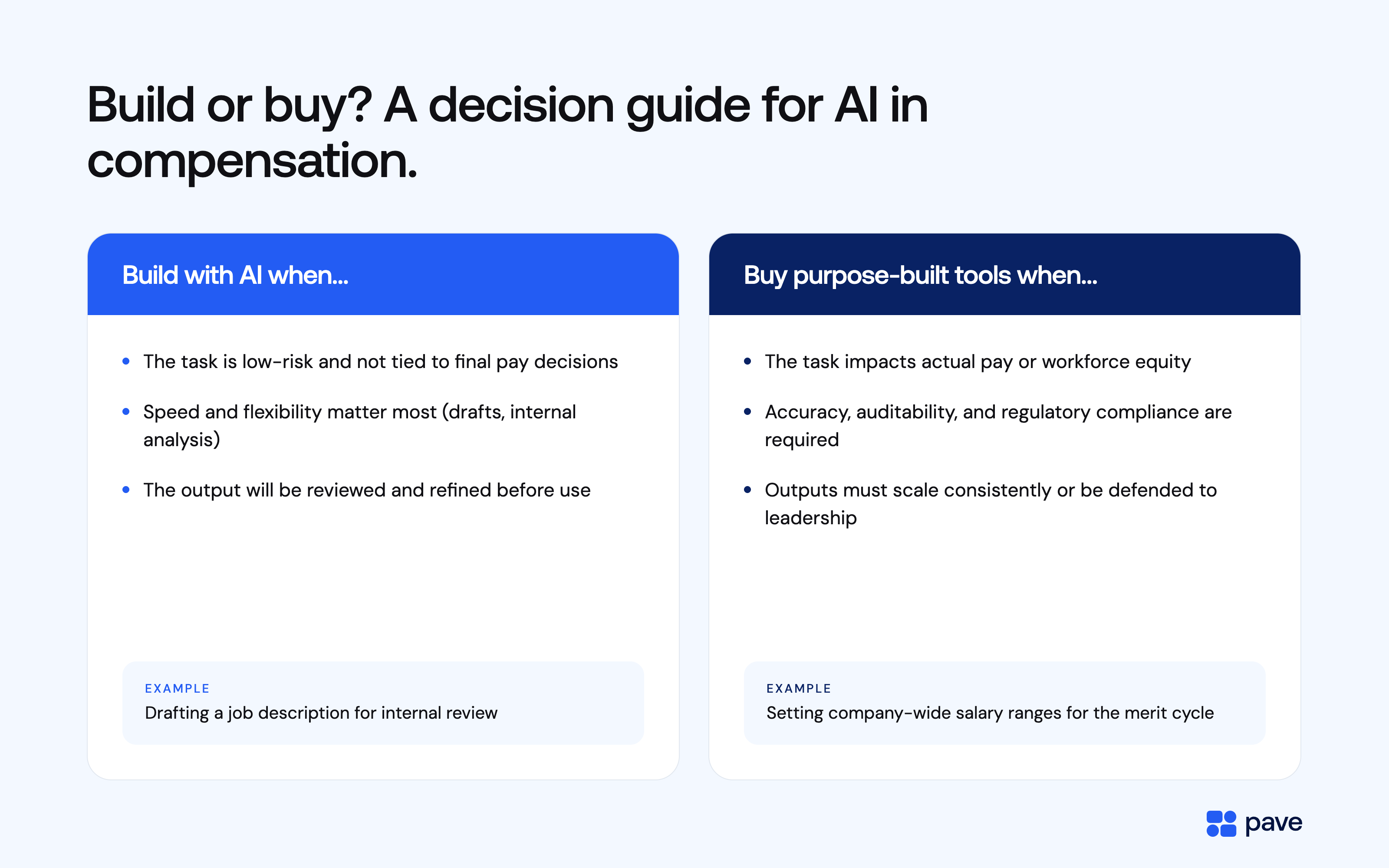
Build when:
- The task is low-risk and not directly tied to final pay decisions
- Speed and flexibility matter most (such as creating a draft or internal analysis)
- The output will be reviewed and refined before implementation
Buy when:
- The task impacts actual pay or workforce equity
- Audit requirements, accuracy, and regulatory compliance are needed
- Outputs must scale consistently across the organization or be defended to stakeholders
For example, drafting a new job description for internal review would qualify as a build, while setting company-wide salary ranges for the annual merit cycle would require a buy approach. This clarity helps guard against the inadvertent accumulation of compensation debt when treating strategic outcomes as temporary solutions.
This design principle guides Pave’s approach. The Pave Agent, our AI compensation analyst, operates on a deliberate advisory model: it recommends actions and provides supporting rationale, while you retain decision-making authority. Each response includes data sources, confidence scores, and compensation-specific caveats. It is purpose-built on real-time data from over 9,000 companies and integrates with your pay philosophy, leveling framework, and internal equity data.
This distinction—advisory rather than autonomous—is not a limitation. It allows organizations to benefit from AI’s speed without incurring compensation debt. An agent that states, “I recommend adjusting this salary to $X based on the following data,” operates appropriately. One that states, “I’ve adjusted this salary,” crosses a boundary that regulators are increasingly defining.
From Administrators to System Architects
The key takeaway from the vibe compensation issue is that as AI manages more operational tasks, both within and outside the compensation function, the strategic importance of the compensation role increases.
Fairness, explainability, incentive alignment, and workforce trust require active management. These responsibilities cannot be automated and are fundamental to the purpose of compensation teams. As anyone in the organization can now generate compensation outputs with a prompt, the compensation team’s role shifts from producing analysis to governing the systems that produce it.
Leaders who succeed in this environment will neither resist AI nor adopt it without scrutiny. They will transition from process administrators to system architects, designing governance frameworks, decision guardrails, and trust infrastructure to ensure AI-assisted compensation remains sustainable, regardless of who initiates the query.
Our maturity research demonstrates this clearly: organizations with both governance and implementation achieve a 50% business impact rate, nine times higher than those with neither. The key is not simply more or less AI, but AI supported by a robust architecture.
If you are ready to move beyond vibe compensation, take Pave’s AI Maturity Self-Assessment to evaluate your organization’s current state, or explore The Pave Agent to see purpose-built compensation AI in action.

Charles is a member of Pave's marketing team, bringing nearly 20 years of experience in HR strategy and technology. Prior to Pave, he advised CHROs and other HR leaders at CEB (now Gartner's HR Practice), supported benefits research initiatives at Scoop Technologies, and, most recently, led SoFi's employee benefits business, SoFi at Work. A passionate advocate for talent innovation, Charles is known for championing data-driven HR solutions.