
Key takeaways
- SaaS sales compensation must reinforce recurring revenue, not just bookings.
- Incentives should reward retention and expansion, not only new logos.
- Compensation insights from software companies remain relevant because SaaS companies compete within the same go-to-market hiring markets.
- OTE and quota design should protect unit economics as ARR scales.
- Data-driven platforms like Pave enable smarter, market-aligned compensation decisions.
SaaS software sales compensation plans form the backbone of revenue performance. Yet many organizations design plans that either overpay for short-term wins or under-incentivize long-term customer value.
These plans differ significantly between roles, such as Sales Development Representatives (SDRs) and Account Executives (AEs). SDRs typically operate with higher base-heavy structures tied to meeting generation, while AEs carry larger variable components aligned to closed revenue.
Modern SaaS compensation models often include accelerators for exceeding quota and protective mechanisms such as clawbacks for early churn. The objective is alignment between sales incentives and long-term revenue outcomes.
As SaaS companies scale, compensation structures should be revisited regularly—especially when hitting key ARR milestones, expanding into new markets, or shifting upmarket. Plans that work in early-stage growth rarely remain optimal at scale.
When the compensation structures align with business goals, sales incentives are more likely to reinforce sustainable revenue outcomes.
Understanding the Basics of SaaS Sales Compensation
SaaS sales compensation requires a different mindset than traditional software sales.
In legacy software models, revenue was largely transactional. In SaaS, revenue compounds. Retention and expansion often matter as much as initial acquisition.
If your plan only rewards new logos, reps may close customers who churn quickly. Strong SaaS compensation structures balance:
- New customer acquisition
- Contract length
- Expansion revenue
- Customer retention
The recurring revenue model demands alignment between sales incentives and long-term revenue health.
While compensation data is typically reported at the broader “software companies” level, these market insights are highly relevant for SaaS organizations competing in similar hiring environments.
Core Components of SaaS Compensation Plans
Most SaaS sales compensation plans include three foundational elements: base salary, variable incentives, and performance metrics. Together, these components determine how compensation rewards revenue outcomes and align with company growth objectives.
- Base salary provides stability and helps attract experienced revenue talent.
- Variable compensation drives behavior by linking earnings to measurable outcomes. Effective incentive structures reinforce revenue quality, not just revenue volume.
- Performance metrics ensure alignment with the company strategy and define how quota attainment and sales performance translate into earnings.
Base-to-variable structures vary by role and sales complexity. Pipeline-generation roles typically operate with more base-heavy compensation structures because they influence pipeline creation rather than closed revenue.
These compensation structures reflect how much control each role has over revenue outcomes rather than arbitrary pay ratios.
How SaaS Differs From Traditional Software Models
SaaS revenue models introduce different incentive priorities compared with legacy software businesses.
Traditional software sales often focused on large upfront transactions. SaaS revenue compounds over time through subscription renewals and expansion.
Because of this, effective SaaS compensation plans must account for more than initial bookings. Incentives are often considered:
- Annual or multi-year contract value
- Net revenue retention
- Expansion revenue
However, compensation benchmarking still largely relies on broader software company datasets. These benchmarks remain relevant because SaaS organizations compete for talent within the same go-to-market labor markets.
For compensation leaders, the key challenge is balancing market competitiveness with recurring revenue economics.
Setting the Right On-Target Earnings
On-target earnings (OTE) define total compensation at full quota attainment. For SaaS companies, getting OTE right is not just about competitiveness—it’s about capital efficiency.
Recent findings from Pave’s 2026 Compensation Budgets & Trends Report show that software companies are tightening compensation budgets while still competing aggressively for revenue talent. This makes disciplined OTE calibration critical.
Note: Most SaaS organizations benchmark against broader software company compensation data. While not SaaS-exclusive, these datasets reflect the same Go-to-Market (GTM) hiring markets.
As funding environments shift toward efficiency, many software companies are aligning OTE and quota expectations more closely to productivity metrics and ARR contribution rather than pure growth-at-all-costs models.
For SaaS leaders, that means compensation must balance attraction with sustainability.
How SaaS Sales Compensation Structures by Role
Sales compensation structures vary by role because different positions influence outcomes in different ways.
Pipeline-generation roles such as Sales Development Representatives (SDRs) typically operate with more base-heavy compensation structures because their primary responsibility is generating qualified opportunities rather than closing deals.
Account Executives (AEs), who close revenue and carry quota responsibility, often operate with more balanced base-to-variable compensation structures.
Enterprise-focused roles may carry greater variable opportunity due to larger deal size, longer sales cycles, and higher revenue impact.
Compensation design should ultimately reflect factors such as deal size, sales cycle length, and revenue strategy.
Determining Salaries Through Total Rewards
Base salary is only one component of a competitive compensation package. Compensation leaders typically evaluate salary alongside variable incentives, equity participation, and benefits within a broader Total Rewards framework.
For SaaS revenue roles, benchmarking salary in isolation can create distortions in compensation design. Evaluating pay holistically helps ensure compensation remains competitive while supporting a long-term compensation strategy.
Research from the Pave and Newfront Total Rewards Report highlights how organizations increasingly assess compensation packages across multiple components rather than focusing on salary alone.
Aligning Compensation With Business Goals
Compensation design is one of the most direct ways SaaS organizations influence sales behavior.
For SaaS revenue teams, effective compensation design requires clear differentiation between top performers, consistent quota achievers, and underperformers. Structured frameworks that tie pay directly to measurable outcomes reduce subjectivity and improve retention among high-impact contributors.
Software companies that align compensation to measurable ARR drivers—such as annual contract value, multi-year commitments, and expansion revenue—create clearer growth pathways.
Compensation should not simply reward activity. It should reinforce strategic objectives.
Incentivizing Annual Contracts Over Monthly
Annual contracts provide revenue stability and reduce churn exposure.
Many SaaS compensation plans reward longer commitments with enhanced commission rates or accelerators. The goal is to reinforce durable ARR, not just new bookings.
Rewarding Expansion Revenue
Expansion revenue refers to additional revenue from existing customers through upgrades, add-ons, or increased usage. It is widely considered one of the most efficient growth drivers in SaaS.
For SaaS businesses, this presents an opportunity.
Expansion-focused roles can be structured with:
- Higher variable weighting is tied to net revenue retention
- Strategic equity refresh grants
- Long-term retention incentives
Aligning cash and equity incentives strengthens long-term revenue durability. Pave's State of Equity Compensation report shows that equity strategy increasingly complements cash incentives for high-impact roles across software companies.
Implementing Your Compensation Plan
Implementation determines success. Provide clear documentation, communicate earnings scenarios, and allow sufficient notice before changes take effect.
Compensation technology reduces calculation errors and increases transparency. Leveraging a compensation management platform like Pave unifies HRIS, ATS, and equity data, helping SaaS organizations like Databricks and Chronosphere streamline their compensation management at scale without spreadsheet risk.
Rolling Out Changes to Your Sales Team
Communication strategy makes or breaks your rollout.
- Start with a clear explanation of why changes are happening. Reps need context to understand and accept new structures.
- Share market data showing how the new plan keeps compensation competitive with compensation structures used by similar Saas organiztions. Explain how changes align with company goals and create opportunities for higher earnings.
- Hold multiple sessions to discuss the plan. Start with a company-wide announcement covering high-level changes, followed by team-specific sessions, diving into role-specific details.
- Schedule one-on-one meetings with top performers who might have concerns.
- Create documentation including FAQs, calculation examples, and comparison scenarios.
Reps should understand exactly how the new plan affects their earnings potential.
Tracking Performance and Adjusting
Ongoing monitoring helps compensation leaders identify structural issues.
Track key metrics weekly during the first quarter after implementation. Watch for unexpected behaviors or gaming that might indicate design flaws.
Monitor:
- Quota attainment rates
- Average deal size
- Discount behavior
- Sales cycle length
If performance shifts unexpectedly, review the structure. Quarterly tactical reviews and annual strategic reviews keep compensation aligned with the SaaS growth stage.
Compensation plans should evolve as your revenue motion matures.
Designing SaaS Sales Compensation for Predictable Growth
SaaS software sales compensation is not just about paying reps. It is about designing incentives that protect recurring revenue and fuel sustainable growth.
The right plan aligns OTE with quota, rewards durable ARR, and evolves as your company scales from early traction to enterprise maturity. While benchmarks are often reported at the broader software company level, they provide critical guidance for SaaS organizations competing in the same talent markets.
Leading SaaS companies treat compensation as a growth lever. They use real-time, align pay with performance, and use technology to eliminate guesswork.
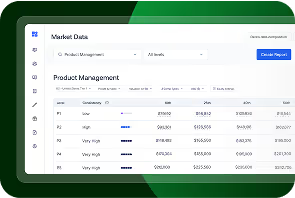
Pave helps SaaS leaders build market-aligned sales compensation strategies through real-time benchmarking, compensation planning, and transparent Total Rewards tools.
Ready to design a SaaS sales compensation plan that drives predictable ARR growth? Explore how Pave can support your strategy today.

Pave is a world-class team committed to unlocking a labor market built on trust. Our mission is to build confidence in every compensation decision.
Frequently Asked Questions
What is a typical SaaS sales compensation plan structure?
A typical SaaS sales compensation plan includes three components: base salary, variable commission, and performance metrics tied to quota. Revenue-closing roles, such as Account Executives, usually have balanced base and variable splits, while pipeline-generation roles like SDRs carry more base-heavy structures. Plans often include accelerators for exceeding quota and may incorporate incentives tied to contract length or expansion revenue. While most benchmark data is reported at the broader “software companies” level, these structures are widely applicable to SaaS organizations operating in recurring revenue models.
What is the ideal base-to-variable split for SaaS sales?
There is no universal split, but structures typically reflect role responsibility and control over revenue outcomes. Pipeline-generation roles often operate with more base-heavy splits. Revenue-closing roles tend to carry balanced or variable-heavy structures. Enterprise sellers often operate with higher performance-based weighting due to larger deal sizes and longer cycles. The correct split depends on your sales cycle, average contract value, and growth strategy.
Should SaaS companies pay commission on renewals?
It depends on your revenue strategy. Some SaaS companies pay renewal commissions to encourage long-term relationship management. Others taper renewal payouts over time while rewarding expansion revenue more aggressively. If customer retention and net revenue retention are strategic priorities, compensation should reflect that. Incentives tied solely to new business may unintentionally increase churn risk.
How often should SaaS sales compensation plans be reviewed?
SaaS sales compensation plans should be reviewed at least annually, with additional evaluation during major growth milestones such as significant ARR expansion, sales team scaling, or shifts in the target market. Quarterly performance reviews can identify structural issues early. Annual reviews allow strategic recalibration based on market data and business priorities. Data-driven tools like Pave enable SaaS leaders to evaluate compensation alignment using real-time compensation data and internal performance metrics.