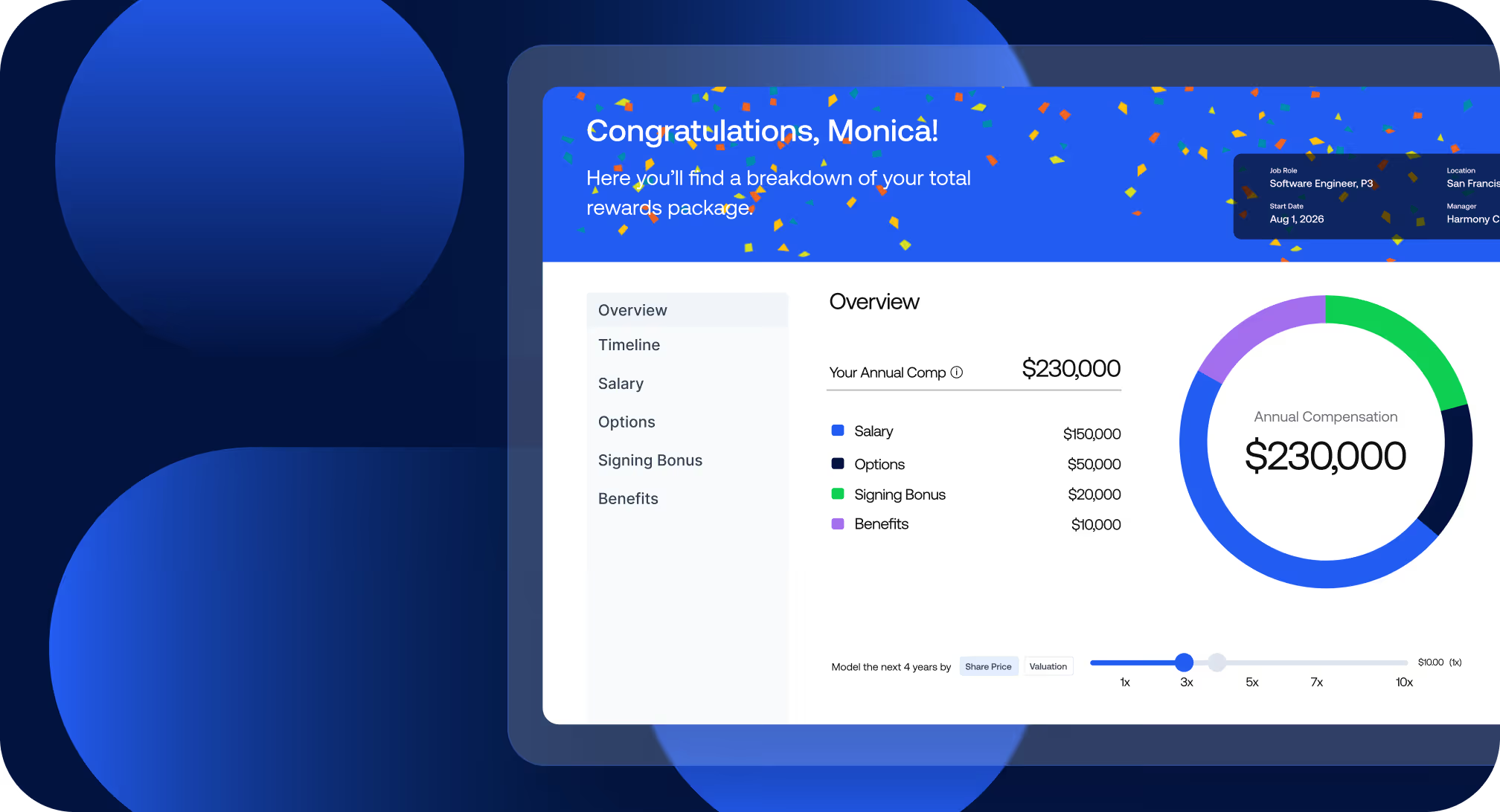
Most companies treat offer letters as a formality—a transactional document that confirms salary, equity, and a start date. But for the candidate on the other end, the offer letter is something far more significant: it's the first real window into how your organization thinks about compensation.
And right now, most companies are getting it wrong.
Static PDFs with raw numbers and dense legal language don't just fail to excite candidates—they actively create confusion. Equity grants are listed without context. Benefits are buried in attachments. The total value of your offer is invisible at the moment it matters most. The result is predictable: candidates call their recruiters with basic questions, compare offers using incomplete information, and sometimes walk away from genuinely competitive packages because they couldn't see it.
The Cost of Losing Candidates at the Finish Line
Appcast's 2026 Recruitment Marketing Benchmark Report, which analyzed over 27 million job applications from nearly 1,200 employers, revealed a counterintuitive trend—cost-per-click, cost-per-application, and cost-per-hire all rose steadily throughout 2025 despite a softer labor market. The median cost-per-hire rose YoY to $1,340.
For key occupations, the math is even more striking. Technology roles carry a cost-per-hire of $2,795. Healthcare sits at $2,100. Manufacturing comes in at $1,046.
This is the context every talent acquisition leader needs to internalize: you're spending more than ever to get candidates to the offer stage. On average, organizations invest $758 in recruitment marketing costs alone to bring a single candidate to an offer—and then lose roughly one in four at the finish line. In technology, that's potentially $2,800 walking out the door every time a role doesn't close.
Every dollar invested in the top of the funnel is wasted if the offer experience fails to convert. That's why forward-thinking organizations are treating the offer letter not as a formality, but as a strategic conversion tool—and why investing in how you present compensation to candidates has never had clearer ROI.
The Offer Letter Gap
HR and compensation teams invest enormous effort in designing competitive pay programs. Market pricing, pay philosophy, equity strategies, benefits design—these are sophisticated, deliberate decisions. But the moment all of that work reaches a candidate, it's flattened into a plain-text email or a static PDF that strips away all the context.
This is the offer letter gap: the disconnect between the value you've built and the value a candidate actually perceives.
Consider how candidates evaluate offers today. They're cross-referencing numbers on Levels.fyi. They're asking peers on Blind. They're running mental math on equity grants they don't fully understand, using assumptions that may be wildly off. Without clear context from you, candidates fill the gaps with their own narratives—and those narratives rarely work in your favor.
Recruiters feel this gap acutely. Hours are spent fielding questions about vesting schedules, explaining how benefits factor into total compensation, and walking candidates through the math that a well-designed offer letter could communicate in seconds.
Consider the scale: according to Pave Data Lab benchmarks, the median recruiter closes roughly 15–18 hires per year—about four to five per quarter. At the 75th percentile, that number ranges from 25 to 30. Every unnecessary hour spent explaining an offer that should speak for itself is an hour not spent sourcing, building a pipeline, or closing the next candidate. Multiply that across your recruiting team and the efficiency cost becomes significant. It's not just inefficient—it introduces risk. Every back-and-forth is an opportunity for a candidate to lose momentum or entertain a competing offer.
What Candidates Actually Need From an Offer Letter
The best offer letters don't just list compensation components—they tell a story. They answer the questions candidates are already asking themselves:
"What is this offer actually worth?" Candidates need to see total compensation at a glance—not just base salary, but how bonus targets, equity, and benefits come together into a complete package. When the total value is presented visually and clearly, it reframes the conversation from "Is the base high enough?" to "This package is more than I realized."
"What could my equity be worth?" Equity is often the most valuable—and most misunderstood—part of a compensation package. Candidates who can't model their equity's potential value will undervalue it or discount it entirely. Interactive tools that let candidates explore vesting timelines and share-price scenarios turn abstract grant sizes into tangible future wealth, making your equity story real and compelling.
"How does this compare to what I have today?" Candidates aren't evaluating your offer in a vacuum. They're weighing it against their current compensation, competing offers, and their own expectations. The more clearly you present every element—including employer-paid benefits that candidates often overlook—the stronger your position becomes.
"Is this a company that values transparency?" The offer experience is a preview of what it's like to work at your organization. A clear, well-designed offer letter signals that you take compensation seriously, that you respect candidates' time and intelligence, and that transparency isn't just a talking point—it's how you operate. It's the same principle that makes an always-on total rewards portal so powerful for existing employees—applied to the candidate experience from day one.
Principles of a High-Impact Offer Letter
- Lead With the Full Picture
- The most important number in your offer letter isn't base salary—it's total compensation. Yet most offer letters bury total comp or don't calculate it at all. Leading with a clear, visual summary of the entire package immediately changes how candidates perceive your offer. When the first thing a candidate sees is the complete value you're offering, every subsequent detail reinforces that value rather than raising new questions.
- Make Equity Tangible
- For companies that offer equity, this is where most offer letters fall short. A grant of 10,000 shares means nothing without context. Candidates need to see how their equity vests over time, what it could be worth under different scenarios, and how it fits into their total compensation picture. When equity is modeled interactively rather than stated as a flat number, it becomes a compelling reason to join.
- Don't Hide Benefits
- Health insurance, retirement contributions, wellness programs, parental leave—these represent real, significant value that employers pay for. Yet they're routinely relegated to a separate benefits guide that candidates may or may not open. Integrating benefits into the offer letter, with clear monetary values where possible, ensures that candidates see the full investment your company is making in them.
- Brand the Experience
- Your offer letter is a brand touchpoint. It should look and feel like your company—not like a generic template. Custom branding, company values, and a thoughtful candidate experience signal that you've put care into this moment. In a process where candidates are comparing multiple offers side by side, the one that feels intentional and polished stands out.
- Enable the Entire Hiring Team
- Great offer letters don't just serve candidates—they equip the people delivering and discussing the offer. When hiring managers can see the same dynamic view that candidates receive, they're prepared to walk through total compensation confidently, answer equity questions, and reinforce why your offer is compelling. Recruiters benefit too: when offers are generated automatically and synced with your ATS, the administrative burden drops and the focus shifts to what matters—closing candidates.
From Transactional to Strategic
The Appcast data makes the business case unmistakable: with cost-per-hire rising across the board—and dramatically so in high-value roles—every point of conversion in the hiring funnel deserves scrutiny. The offer stage is where organizations have the most control over the candidate experience and where small improvements in clarity and communication can yield outsized returns.
In a world where compensation strategies are growing more complex—blending cash, equity, benefits, and long-term incentives—the companies that communicate that complexity clearly will have a meaningful advantage in hiring. Your offer letter is your first chance to demonstrate that clarity. Make it count.
Curious how leading talent teams are rethinking the offer experience? See a sample Visual Offer Letter to experience it firsthand, explore Pave's ATS integrations, or request a demo to learn how Pave can help you close candidates faster.

Charles is a member of Pave's marketing team, bringing nearly 20 years of experience in HR strategy and technology. Prior to Pave, he advised CHROs and other HR leaders at CEB (now Gartner's HR Practice), supported benefits research initiatives at Scoop Technologies, and, most recently, led SoFi's employee benefits business, SoFi at Work. A passionate advocate for talent innovation, Charles is known for championing data-driven HR solutions.
What is a visual offer letter?
A visual offer letter is a dynamic, interactive digital offer that presents a candidate's total compensation package—including base salary, bonuses, equity, and benefits—in a clear, branded visual format rather than a static PDF or plain-text email. Explore Pave's Visual Offer Letter.
Why do traditional offer letters lose candidates?
Static offer letters list salary and equity as raw numbers without context. Equity grants aren't explained, benefits are buried in attachments, and total compensation value is invisible. Candidates fill the gaps with incomplete information from peers and salary sites, often undervaluing competitive offers and walking away.
How do visual offer letters help close candidates faster?
Visual offer letters reduce recruiter back-and-forth by letting candidates explore their total compensation, model equity scenarios, and see benefit values on their own. This self-service experience answers common questions before they're asked, shortening time-to-close and freeing recruiters to focus on sourcing and pipeline.
What is equity modeling in an offer letter?
Equity modeling lets candidates interactively explore what their equity grant could be worth over time under different share-price scenarios and vesting timelines. This turns an abstract grant number into a tangible picture of future value, helping candidates appreciate the full weight of an equity offer.
Do visual offer letters integrate with ATS platforms?
Yes. Modern visual offer letter tools integrate with applicant tracking systems to automate offer generation, sync candidate data, and streamline the approval workflow—eliminating manual creation and ensuring every candidate receives a consistent, on-brand experience. See Pave's full list of ATS integrations.